Contents06 sections
Monday, 7 am. The head of work preparation spends the first hour on the phone. The hardening shop: when are the shafts coming back? Purchasing: has the order confirmation for the bar stock arrived? Programming: is the NC program for tomorrow morning's machine slot released? The answers exist somewhere. In an e-mail, in a PDF, in an Excel list. Just not where he needs them.
In the afternoon, the parts come back from hardening two days late. Grinding is still planned for the old date. The customer notices on Friday.
The machines weren't the problem this week. They never were.
The order sits, it doesn't move
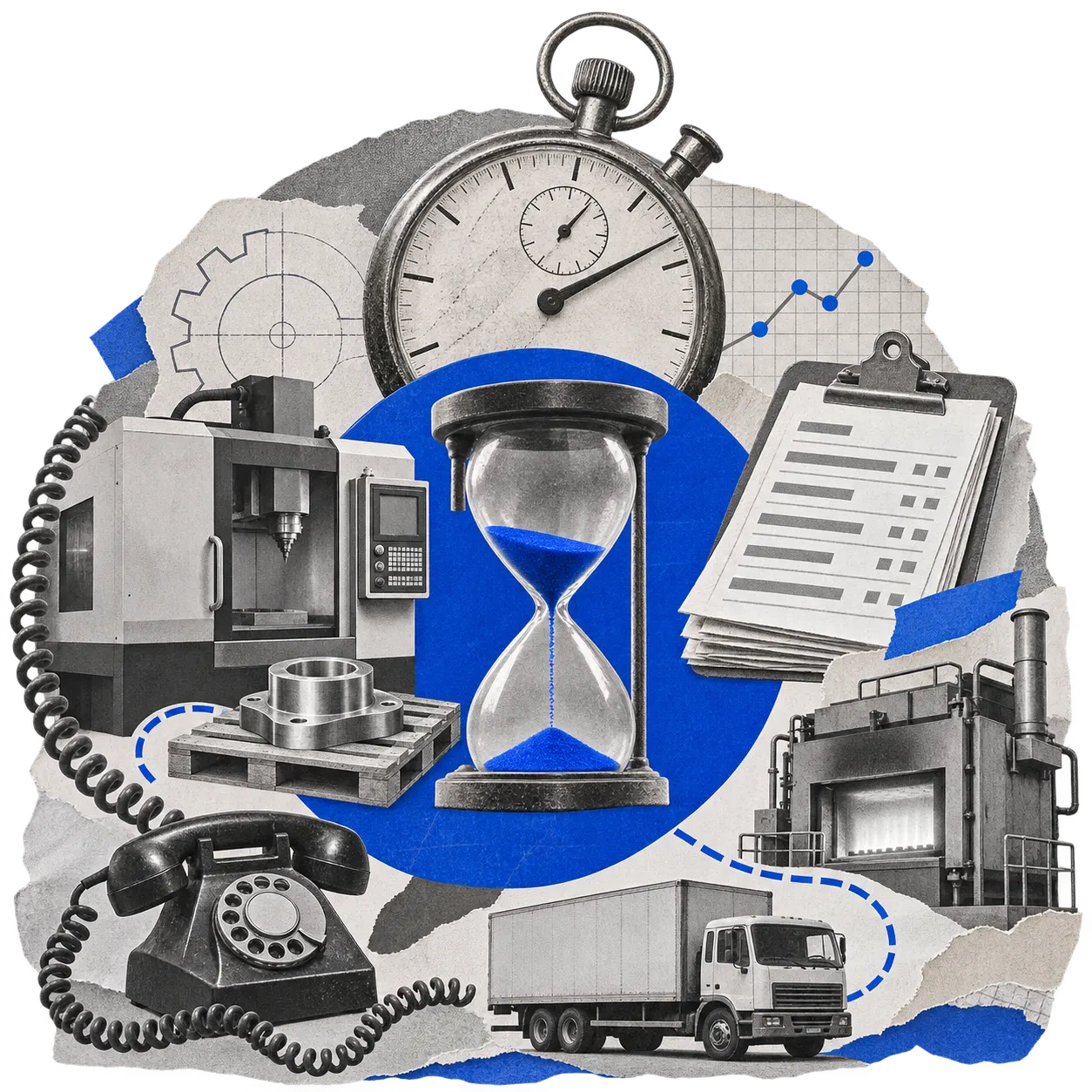
Follow an order through a job shop and you find something uncomfortable: most of the time, nothing happens to it. Hans-Peter Wiendahl showed this with a practical job-shop example. Setup and machining together took only about 10 percent of the lead time. For about 85 percent, the order simply sat there.
That is one example, not a law of nature. But anyone who has ever followed an order with a stopwatch knows the pattern. The order waits for material. For a program. For release. For the hardening shop, the plater, the coater. For a material certificate without which it can't ship. Each of these waits belongs to a different person and lives in a different system.
More orders, fewer people
At the same time, things are getting tighter. German machine-tool makers report 14 percent more orders for the first half of 2026, but headcount is just over 6 percent lower than a year earlier. The orders are coming back. The people aren't.
And the money for the big leap isn't there either. According to the KfW SME Panel, a third of German SMEs with investment plans postponed or scaled them back in 2026, more than ever recorded.
This is exactly when many reach for the familiar reflex: another machine, a faster one, one with more axes. Understandable. But if the order spends 85 percent of its time waiting, a faster machine shrinks the 10 percent even further. You optimise the part that already works.
The foreman is the only system that sees everything
Why does this so rarely show? Because the waiting isn't recorded anywhere. The ERP knows the routing. The machine knows its run time. The e-mail knows the hardening shop's new date. The Excel list knows the supplier's status. And two or three experienced people know the rules of thumb that are written down nowhere.
One person pulls it all together: the foreman or the work planner with a phone in hand. He is the plant's only integration system. As long as he is there and has time, it somehow works. When he is ill, on holiday or retired, you see immediately how much he was holding together.
Don't get me wrong: this is no criticism of the people. They do a great job. It is a criticism of a setup that relies on one person keeping everything in their head.
To be fair: sometimes it is the machine
Real bottlenecks exist. The one five-axis machine where everything piles up. The grinding department that has been full for months. If you have a bottleneck like that, remove it, and sometimes that means investing.
You only know once you have measured it, though. And in my experience the measurement almost always shows something different from the gut feeling. The machine everyone complains about is itself waiting for programs. The supposed bottleneck is an information bottleneck.
Measure first, then buy
What this means in practice:
First: follow three real orders. From order confirmation to shipping, together with the people who handle them. Note when someone works on the order and when it waits. The result is sobering and very instructive.
Second: name every wait. Material, program, release, outside processing, documents. Who is responsible, and in which system is the status?
Third: connect what already exists. The data for a better view of every order is usually already in the building. It's just scattered.
Fourth: invest in machines only when the machine is the bottleneck. Not when the problem merely feels that way.
Orders aren't lost at the machine. They're lost in the waiting. And you only see the waiting if you look.
Sources
- H.-P. Wiendahl, job-shop example: about 10 % of lead time setup and machining, about 85 % waiting caused by inventory; Wiendahl (2010), p. 31, cited in C. Niehues, Adaptive Produktionssteuerung für Werkstattfertigungssysteme, doctoral thesis, TU Munich, Herbert Utz Verlag (2016), ch. 1 — utzverlag.de
- VDW press release, 9 September 2026: German machine-tool orders up 14 % in the first half of 2026, up 12 % in the second quarter; about 60,000 employees in June 2026, just over 6 % fewer than a year earlier — vdw.de
- KfW SME Panel 2026 (October 2026), p. 18: 33 % of SMEs with investment plans postponed or scaled them back, the highest value ever recorded; special survey September 2026, n = 2,051 — kfw.de