Table of contents03 sections
DefinitionTotal cost of ownership
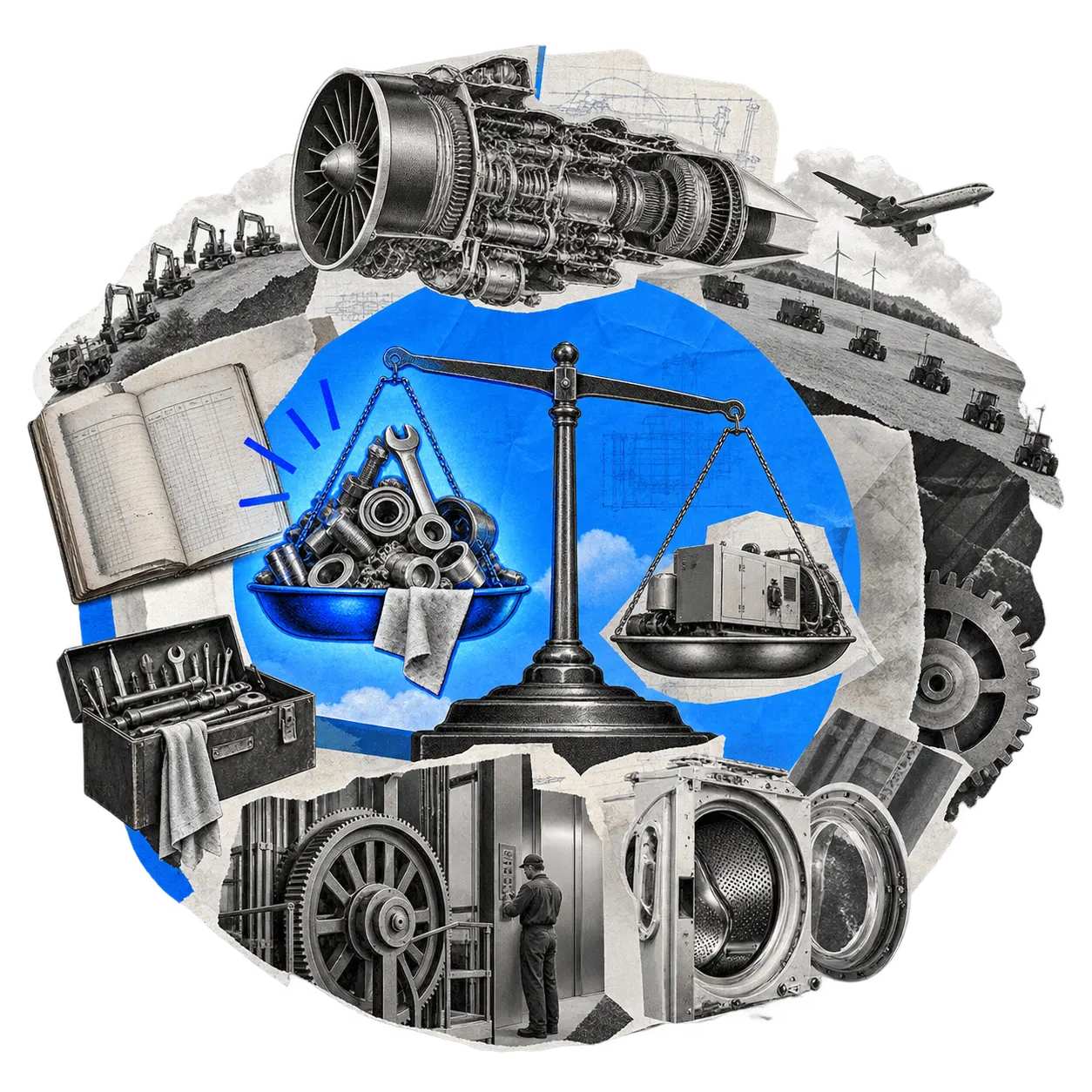
Total cost of ownership, or TCO, is the sum of all costs a product causes over its entire service life: purchase, installation, energy, consumables, maintenance, repair, downtime, training and disposal. For industrial goods the purchase price is often only a small share of that sum.
What belongs in the calculation
TCO breaks into three phases. Before operation: purchase, transport, installation, commissioning, initial training, adaptations to building or process. During operation: energy and operating fluids, consumables, scheduled maintenance, repairs, spare parts, software and licence cost, labour, downtime cost. At the end: dismantling, disposal or recovery — less any residual value.
The item most often missing is downtime. It is the hardest to estimate and often the largest — and because it never appears on a supplier's invoice, it regularly drops out of the procurement view.
Why TCO still loses in procurement
The purchase price is certain, immediately visible and falls into a single budget. Operating cost is estimated, spreads over years and often lands in cost centres other than the investment. Someone steered on a capex budget decides rationally against TCO — that is not a thinking error, it is an incentive problem.
Anyone arguing with TCO has to account for that. A TCO calculation only convinces if it goes to someone who is actually charged with the operating cost — or if it is translated into a commercial model that shares the saving.
TCO as the basis for service models
This is where the calculation gets interesting. If you can demonstrate as a manufacturer that your service lowers your customer's operating cost, you can earn on it — through availability commitments, full-service contracts or usage-based models where you sell not the machine but its output. The precondition is having the operating data to prove the effect. Without measurement it stays a claim, and nobody pays for claims.
In short
TCO is the sum of all costs of a product over its service life — purchase, operation, maintenance, downtime, disposal. For capital goods the purchase price is often the smaller part, which is what makes TCO a selling argument in service.